

How can we better understand the value of investing in community health? A report published by the American Medical Association (AMA) in collaboration with Kearney uses data from West Side United Chicago's (WSUC) Impact Investing program to measure social return on investment. This analysis captures benefits that go beyond financial returns.

How do we measure the impact of investing in our communities?
Investments in local businesses, affordable housing, and community development can create meaningful change, but their value often extends beyond what traditional financial metrics can capture. From creating economic opportunities to strengthening community well-being, understanding the full impact of these investments requires looking beyond the initial loan.
A recent report published by the AMA, in collaboration with Kearney, explores this question using data from West Side United Chicago's Impact Investing program.
Through this program, WSUC works with anchor partners to direct capital toward local businesses and community development projects on Chicago's West Side. By supporting low-interest loans through Community Development Financial Institutions the program aims to expand economic opportunities and support long-term community well-being.
The report, Investing in Community Health: Measuring Social Return on the American Medical Association’s Investment in West Side United’s Impact Portfolio, draws on three loans from our portfolio to demonstrate how the broader social value of community investments can be estimated.
What Does the Measurement Approach Tell Us?
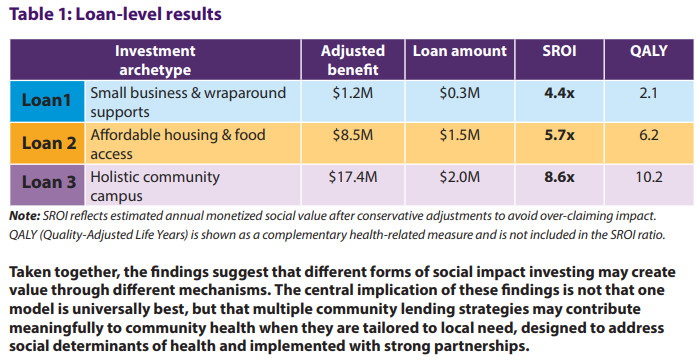
Using three selected loans as examples, the report estimates that every $1 invested could generate approximately $4.40 to $8.60 in annual social value. Across a modeled investment base of roughly $4 million, this translates to more than $26 million in estimated annual social value.
Unlike traditional financial returns, social value captures benefits that extend beyond the investor. These can include employment opportunities, access to essential services, and improvements in the conditions that support healthier, more stable communities.
To calculate these estimates, Kearney examined the activities and outcomes associated with each investment, such as jobs created, access to housing, and support services provided. Using program data, published research, and established economic benchmarks, the team assigned monetary values to these benefits. The estimates were then adjusted to account for factors such as the contributions of other partners and benefits that might still have occurred without the investment. The resulting social return on investment (SROI) ratio compares the estimated annual social value with the amount invested.
These estimates are based on available data and assumptions, rather than audited outcomes or evidence that the investments alone caused every benefit. While they cannot capture the full picture, they offer a way to quantify community benefits in a more holistic way than financial reporting alone.
Three Examples of Community Value
To illustrate how the approach works across different types of investments, the report examines three projects, each addressing community needs in a different way.
A neighborhood restaurant: Beyond creating jobs, the restaurant provides employees with meals, access to affordable health-related services, and opportunities for training and professional development. The estimated annual social return is $4.40 for every $1 invested.
Affordable housing with essential services: This development combines housing with access to healthy food and supportive services, helping residents meet multiple needs within their community. The estimated annual social return is $5.70 for every $1 invested.
A community campus: By bringing together housing, health care, education, food access, recovery supports, and community programming, the campus offers a range of resources in one location. The estimated annual social return is $8.60 for every $1 invested.
While the estimates differ, the projects serve distinct populations and purposes. The figures are not intended to rank the investments but to show how the same measurement approach can account for different types of community benefits.

Measuring What Matters for the West Side Communities
Health is shaped by much more than what happens in a doctor's office. Where people live, work, shop, and access everyday resources all influence their opportunities to lead healthy lives. This connection is central to West Side United's approach to impact investing.
Understanding whether and how these investments make a difference is equally important.
The AMA and Kearney report offers one approach to that challenge, demonstrating how the broader benefits of community investments can be measured. Results from this report can help West Side United Chicago and its investing partners demonstrate the depth of impact, offering evidence that these loans are worthwhile contributions and support West Side residents in meaningful ways.
We appreciate the AMA's continued partnership and Kearney's work in documenting this approach. As we continue investing in Chicago's West Side, understanding and measuring the value of these investments will help inform our work and strengthen how we communicate their impact.